Shop, Click, Heal?

Happy holidays!
‘Tis the season! Now that we’re all stuffed with turkey and have done some of our Black Friday shopping (in person, perhaps?), I wanted to explore what the shopping experience is going to be like this year… and in future weeks, months, and years.
This past week, OpenAI launched their Shopping Research functionality, just in time for the holidays. (Though I wonder—was it a little late?!)
Naturally, I had to try it.
If you haven’t tried it yet, I urge you to do so. In a nutshell, you ask ChatGPT to perform research on a potential purchase. ChatGPT first asks if you want to use “shopping research.” If you say yes, it spends a few minutes asking about your preferences before launching into a search. In this moment, ChatGPT becomes an agent and starts the research process on your behalf.
It’s incredible.
I tried it out for something that would actually be useful to me: suitcase research. I travel a lot. I bought my last suitcase almost a decade ago, and my current Away bag is showing signs of wear, so I thought ChatGPT could help me find reasonable alternatives to consider.
I used OpenAI’s Atlas to ask ChatGPT the following:
I’m looking for the best suitcase for travel. Right now, I use an Away carry on bag right and I like it, but I’m wondering if there are any other similar options like it - durable, stylish, fairly inexpensive, etc. Please compare options for me.
It gave me a typical ChatGPT response, but then it asked me if I wanted to use research, which I was excited to try:
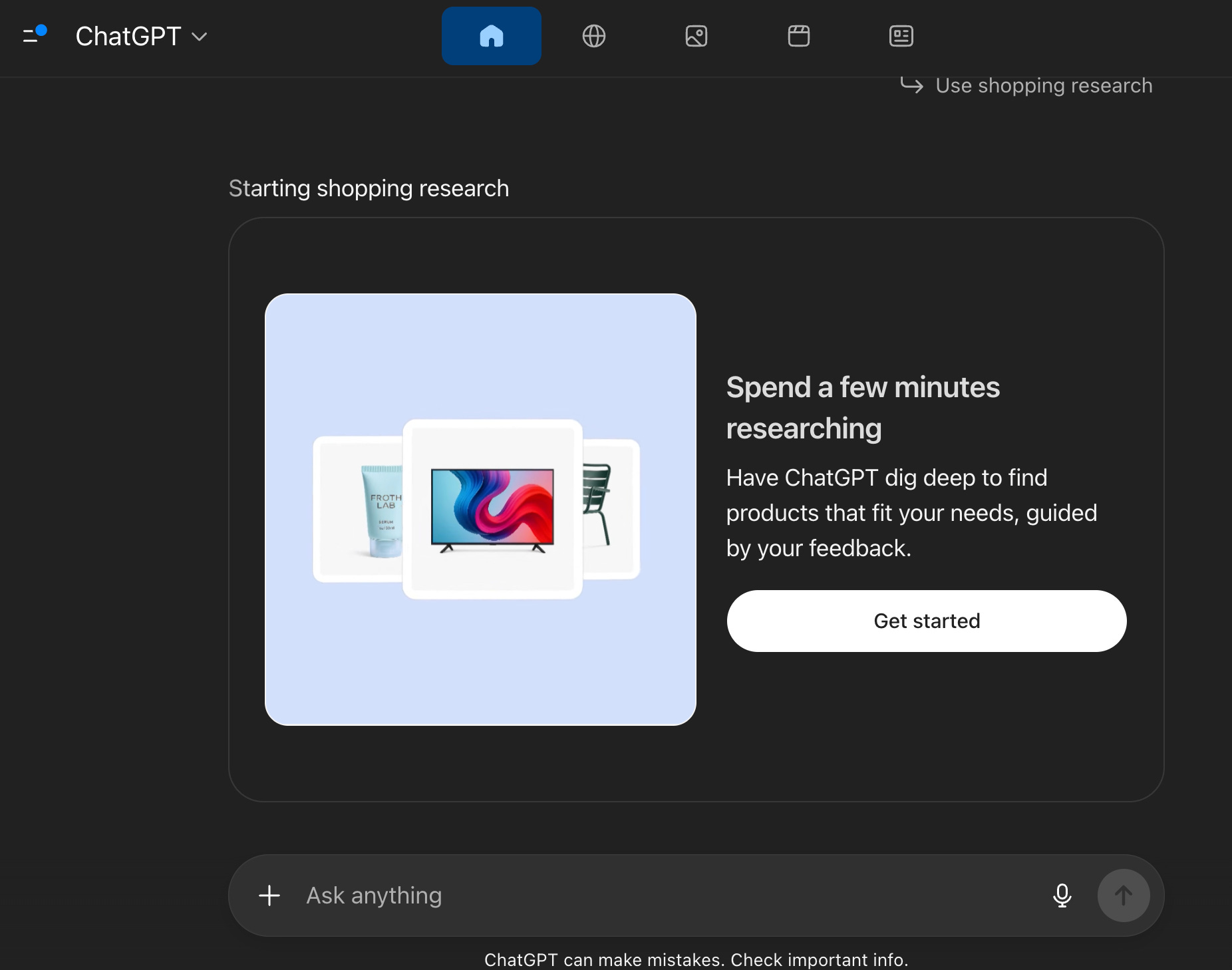
It gathered my preferences and requirements (e.g., Preferred budget? Material preference? My selection priorities?):
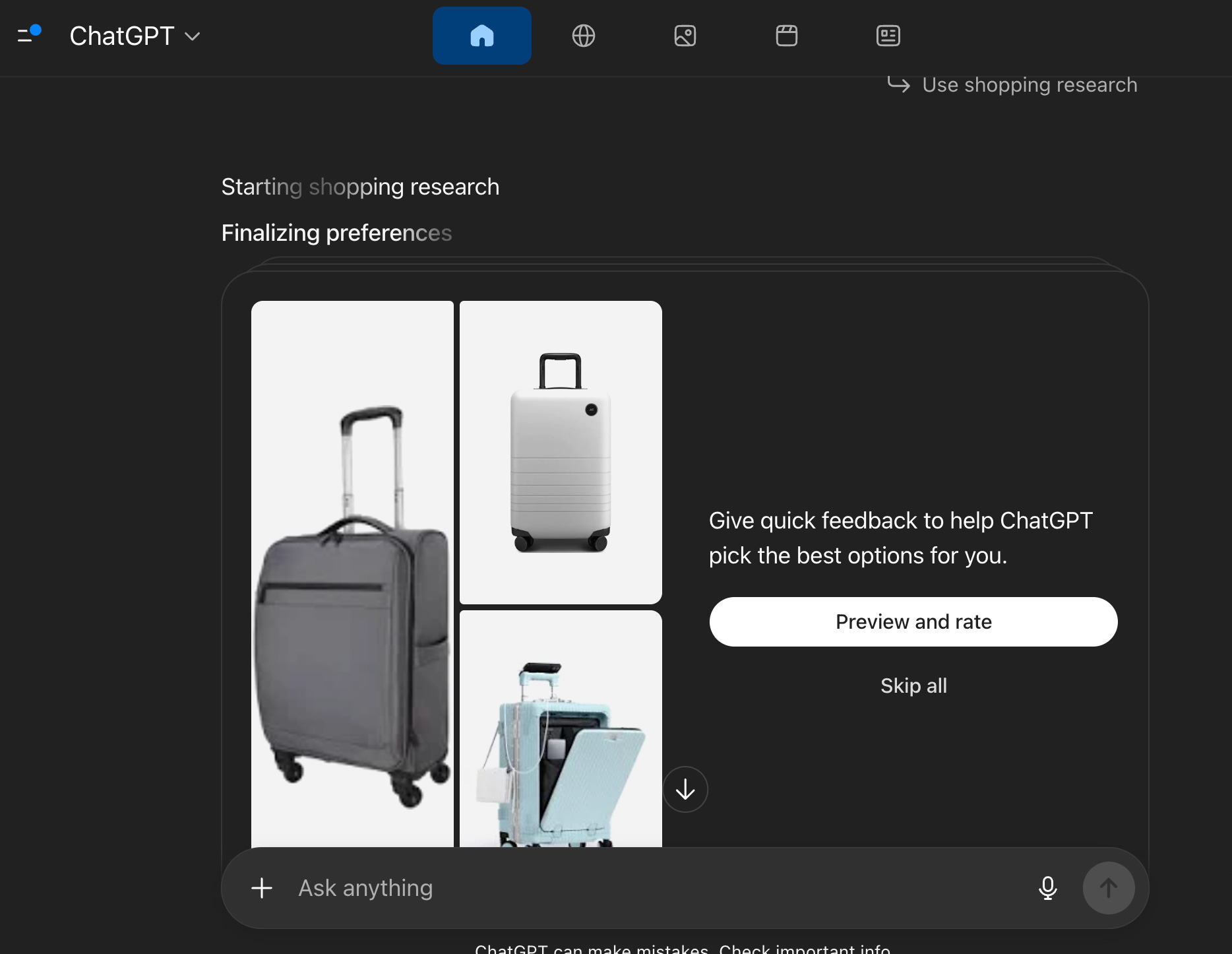
At that point, it took approximately 7-8 minutes to look at 33 different products and different sites, evaluate the suitcase options, and present me with a recommendation based on my request and preferences.
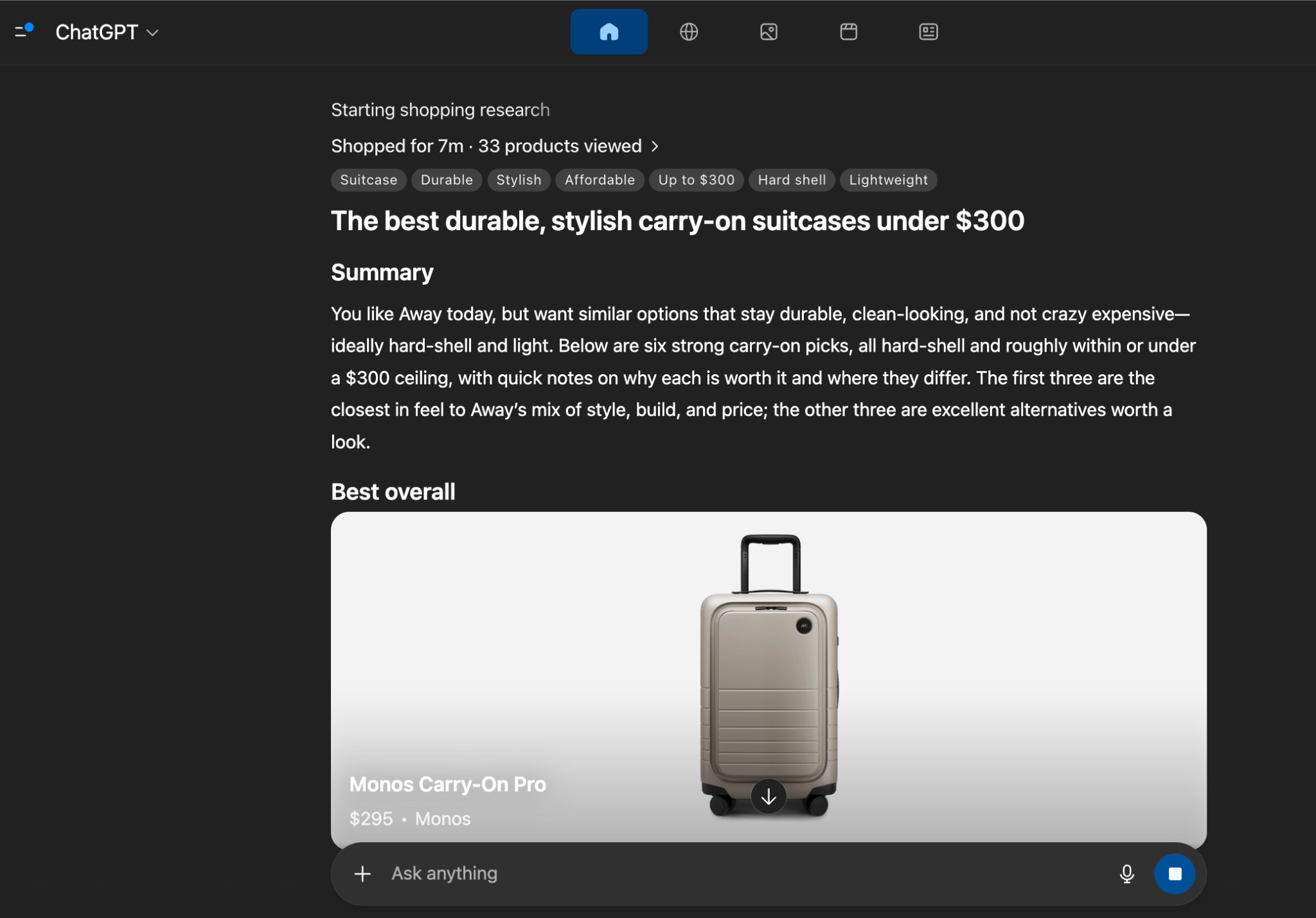
This was pretty jaw-dropping. I didn’t have to do any of the research, visit any of the sites, draw up a suitcase comparison spreadsheet, or even read any reviews. Instead, ChatGPT came back with an excellent analysis of the options and outright told me which product made the most sense based on my preferences.
The only thing it failed on (because I’m not a ChatGPT Plus or Pro user) was that it couldn’t actually buy the product for me. But it was enough for me to experience it and immediately think about what this could mean for healthcare.
So this naturally got me thinking: What if we could shop for doctors in the same way?
I’ve always maintained that a health system is sitting on inventory: doctors and their available time slots. I have talked at length about how health systems need to start thinking about their provider data as inventory. It has always made sense that the internet would move in a direction like what I described above: consumers are ultimately shopping for a person who specializes in something specific, and they want to match that person’s specialty and schedule to their own availability. In many ways, this is exactly how an organization has to manage product inventory: what products (doctors) do we have available today (open time slots) to purchase (book an appointment online)?
Why couldn’t we share healthcare inventory with organizations like OpenAI and Google? OpenAI and Google are actively trying to start their agentic offerings with retail, but why wouldn’t we consider how someone could search for a provider in the future in the same way? Imagine employing an agent to do all the heavy lifting based on a user request (and maybe, by extension, even knowing more about the user because we’ve plugged in our healthcare preferences, diagnoses, test results, etc.). This could potentially eliminate a lot of incorrect appointments, seeing the wrong doctor, or opting not to book an appointment at all due to friction.
Today, healthcare organizations largely do two things to make sure they can get in front of a prospective patient:
They put information on the website and hope to draw people in to find more information and try to book an appointment through SEO and now AEO optimization tactics.
They gather their provider and location data and send that data to places where people might be initiating a search for health information (e.g., Google Business Profiles, Apple Maps, etc.).
Data is often maintained in two places because it has to be maintained in two places. But the assumption for both of these focus areas is that these efforts result in bringing someone to the website to perform the final step—booking the appointment.
The internet is moving away from this behavior of optimize to drive people to a website.
What if there were a possibility to leverage technology to perform provider research (and eventually booking) in the same way I found my suitcase? This would dramatically change how people search for a doctor and would keep people largely off websites.
Instead, the machine would search for a provider. The machine would do the heavy lifting. And, hopefully, in the future, the machine would facilitate the booking of the appointment, too.
This means there will need to be some fundamental differences in how healthcare organizations position their data to be present in these experiences.
We’re already seeing the impact of conversational AI experiences reducing traffic to websites, especially for healthcare. Focusing on building up your website and all that it entails may be a very short-term need and goal; the writing is on the wall regarding where the internet is headed. We need to figure out how to ensure the information that you formerly would leverage to bring someone to the website is accessible by these technologies, allowing you to not only appear there but also transact off-site.
OpenAI, Google, and others are actively moving to a world where they own the end-to-end experience in a closed environment.
The more they focus on helping people find information online and facilitating the transaction, the more they eliminate the need for someone to go to a website. The meaning of the internet is evolving, and the internet as we know it is dying.
In this new shopping world, let’s say it moves into healthcare. This means there are different considerations for how healthcare organizations need to feed information to platforms so that if someone asks an agent to perform shopping research for a provider, you can show up in those results:
Provider Feeds. Instead of sending Name, Address, Phone (NAP) data to listings, provider availability might end up functioning like a Shopping feed. During my time at Google, they launched Google Merchant Center, which allowed organizations to share their product inventory with Google. These feeds set companies up to both track their inventory and drive specific inventory into the Google ads platform. Since these organizations have product feeds, it’s a lot easier for companies like OpenAI to tap into them, too. Instead of simply sending information to Google Business Profiles, you might need to create a provider feed (like a product inventory feed) that you can separately share with Google and OpenAI.
Research Happens Off-site. Instead of healthcare consumers doing deep research about specific conditions and doctors on a health system website, all of that research will take place on ChatGPT and Gemini. Health systems will have to figure out how these organizations will collect and summarize this data. We have to assume that people won’t be visiting a website to do the heavy research anymore and that these platforms will be handling the end-to-end experience. They become the website and your website becomes the app that feeds them.
Transactions will move to agents. Transacting will go from phone calls and light online appointment booking options to fully functioning appointment booking executed by an agent. In all of my non-scientific research studies this year, I have found that when attempting to transact online, people are often pointed to a phone number to call rather than being presented with an appointment booking link. The more we learn about how these agents handle transactions, the more we’ll need to prepare for a world where the agent needs access to online booking options. This means your health system needs to internally understand what is preventing you from online appointment booking today, and also understand how your EHR (ahem, Epic!) is (or is not) preventing you from surfacing scheduling opportunities. This needs to be done yesterday.
I keep saying this: there is a reason why OpenAI and Google are trying to facilitate agentic experiences in retail first. The data (product feed) is easier to read and is highly structured. There is a real opportunity to charge for the transaction/conversion in the future. Of course, there are fewer legal challenges (e.g., HIPAA) to contend with in retail, too. But this doesn’t mean consumers won’t start to adapt to a new shopping behavior and begin to expect this in other areas of their lives. This is coming to healthcare, and healthcare organizations don’t want to be standing at the corner of poor patient experience and technology without a plan to deliver.
Here are some thoughts about what you can do today:
Know where your provider data lives today. It is your inventory. It is constantly changing, so you need to make sure you have a solid strategy for keeping track of it.
Have a conversation with Epic. Help them understand the importance of having up-to-date provider information and scheduling inventory data and why this is important. I can guarantee that this is not top of mind for them and they will be reluctant to allow discoverability of this data. But they do need to get with the program and you can help pressure them to do so.
Optimize your content. Optimizing content to show in conversational AI platforms will continue to be paramount, but you’ll need to make sure your content is associated with your provider inventory. If your provider is a breast cancer specialist, that information needs to be linked to the provider so that when someone leverages conversational AI to search for a specific provider, you’ve sent that information to them for consideration—but also for booking.
Have a plan for online appointment scheduling across all of your providers. This might mean that the health systems working with Epic need to collectively petition them to release their inventory. (Let’s be clear: Epic is a monopoly, no ifs, ands, or buts about it. You’ll have to do a lot of work to liberate the data that should be yours and not theirs.)
Have a plan for complex appointments. How will you accommodate those? What about those that need triaging to make sure certain slots aren’t given to the wrong patients? Have you had these discussions as an organization yet?
Experiment with Shopping Research ASAP. Make sure you have actually tried the Shopping Research experience today and thought about how it could work if someone were searching for a provider in your organization. Consider adding Shopping Research as an “experience” in your Experiences of the Future exercise (that I hope you are conducting every six months or so!). Don’t get left behind - make sure you understand what the technology is doing today and connect it to how a consumer might interact with your organization in the future if it were made available to them in healthcare.
In our industry, we have time, but we also don’t have time. Our considerations are far, far, far more complicated than simply sending a product feed to OpenAI and Google. This is why it’s so important to be thinking about this now. As the internet moves from an open system to a closed system, you have to think about how the information surfaces on other platforms, while also thinking about what is coming next – transacting – and how to ensure you are prepared for driving better patient experiences and acquisition opportunities in the future.